Tuesday, June 3, 2014

Reading...a little non-fiction. A tale of two baby books


The Girlfriends' Guide to Surviving the First Year of Motherhood

I'm not a big non-fiction reader -- I tend to start a lot of non-fiction, then lose steam. But nothing gets me into a non-fiction book faster than that oh-crap-I-don't-know-what-I'm-doing feeling of new parenthood. A friend loaned me The Girlfriend's Guide to the First Year, by Vicki Lovine and, I've got to admit that I didn't love it.
I can't put my finger on anything particularly terrible or offensive, it was just kind of...blah. Not like a girlfriend sharing her experiences in the first year of motherhood, but like a person acting like what they think a girlfriend would act like when sharing her experiences. Some of it was funny, but a lot of it just felt like it was trying too hard. And while it did have some helpful and funny information in it (particularly the section on the birth and post-birth hospital experience), nothing you couldn't find elsewhere.


Sleeping Through the Night, by Jodi Mindell, on the other hand, is excellent. It was gifted to us by a psychologist friend who has actually met the author, a well-known sleep expert. Mindell gives you a lot of general information about sleep in babies, children, and adults. She begins by talking briefly about behavior modification in general (because sleep training is essentially a specific behavior modification), then she lays out simple strategies for getting babies and toddlers to sleep better, and even strategies for adults who have sleep issues. Her approach is very practical, low-key, and adaptable to the personalities of individual parents and children. There's no DO IT THIS WAY NOW. The book is very much "here are some strategies, I think this one works best, but do what works best for you. The main thing is that everyone gets some sleep." She also talks about sleep issues like night terrors, sleep walking, sleep talking, and insomnia (in adults). And if there is any scientific information about sleep or any sleep issue, she gives you the facts and figures in a very understandable and approachable way. Of course, only time will tell how effective I find her information, but from a read-through standpoint, I thoroughly enjoyed it and plan to give her strategy a try.
Sleeping Through the Night: How Infants, Toddlers, and Their Parents Can Get a Good Night's Sleep

Thursday, May 15, 2014

Five reasons to re-read a book

1. Because it's dense and complex and you can get even more from it the second time around.

2. Because it's fun to go back and see the forshadowing for what it is, or to try and spot the clues.

3. Because sometimes you need a little comfort food, or a visit with old friends, and a favorite book is like the best kind of visit home.

4. Because there's nothing new you want to read (hahaha! Does this actually happen to anyone? Because there's always something new -- well, new to me anyway -- that I want to read).

5. Because you need something to read that you can easily pick up and put down because you're reading in snippets in between doing something active yet inactive like nursing -- because you just had a baby.


Number 5 is my current reason.  :-)

Are you a re-reader? Do you pick up familiar books for any of the above reasons, or for something entirely different?

Friday, May 2, 2014

Some new, newish, and in-utero books I want to read

Sinner, by Maggie Stiefvater
I was definitely satisfied by the ending to the Mercy Falls trilogy, and never really expected anything to come along after that, but a book about Cole and Isabel? YES, PLEASE. 

Shadow Scale, by Rachel Hartman
Another sequel that I'm looking forward to reading this year. I loved Seraphina - dragons, music, intrigue, romance.

Blue Lily, Lily Blue, by Maggie Stiefvater
The latest in the Raven Boys quartet. Need I say more?

Dryad-Born, by Jeff Wheeler
It took me a little while to get into Fireblood, the first of this series (apparently, I have a series problem. That or there are just too. many. series.), but once I got going, I really enjoyed it. It's a fantasy with Celtic flavor, some interesting twists and turns, characters that grow on you, and a Big Bad that's still quite a mystery.

Firebug, by Lish McBride
Lish McBride's books make me think of all I loved about Buffy the Vampire Slayer. A little dark, a lot funny, and surprisingly heartwarming. Although this isn't directly related to her Necromancer books, I'm confident it will be just as good. 

Vertigo 42, and The Way of All Fish,  by Martha Grimes
It's been too long since I've spent time with Richard Jury and his friends, so I definitely need to get my hands on Vertigo 42. The Way of All Fish is a companion to Foul Matter, a book I was not expecting, but thoroughly enjoyed. Another darkly funny book -- which apparently I have a thing for.

I've also been eyeing my bookshelves lately -- There's quite a few picked-up-at-the-library-used-book-sale titles and some perks-of-working-at-a-public-library ARCs that I have yet to read. I'm thinking I need resist some of the "shiny and new" and discover whether or not these books are shelf-keepers or not.

Friday, April 25, 2014

Reading...Dreams of Gods and Monsters

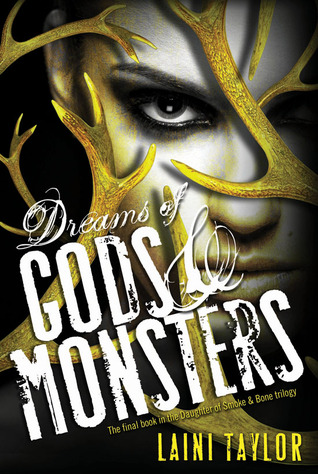
Reading Dreams of Gods & Monsters, by Laini Taylor was bitter-sweet. Bitter because this is the last book of the trilogy -- no more Eretz, Prague, Karou, Akiva, Mik, Zuzana, Kiri, Liraz. Sweet because these books are SO FREAKING AMAZING. Seriously, I love them, and this last installment was no exception. First, of course, is the writing itself. Laini Taylor's writing is evocative and poetic and beautiful, fitting of a story that is part fairy tale, part love story, and part action-war story.

Then there are the characters - these characters go through so much physically and emotionally throughout the books, and Dreams of Gods & Monsters is no exception. They're making hard decisions, trying to bring together centuries-long mortal enemies, trying to forge a new future, learning to move forward, forgive, love. Some characters are wrestling with anger or guilt or despair. There are new players in this book, as nuanced and fleshed out as those characters we've come to know and love, even those characters whose role is a short -- but in no way minor -- one (fake Grandma, I'm looking at you). (And I want to just say that Morgan Toth has taken a place on my top-10 list of characters I want to punch in the face repeatedly. Gah. That guy.).

Last, but not least, there is the story itself. These three books really feel like one long story - each piece building on the last, revealing more and more. What starts out as a simple story of star-crossed lovers becomes something epic and world-changing. There's a sense of looking at a map: in the first book, you're zoomed in on one spot on the map, and at the end of the book you've realized you're looking at a bigger map than you thought. Then in the second book, you zoom out a little more. And in the third -- holy cow! Apparently the map is ten times bigger than you thought it was at the beginning of the first book. I loved the big picture part of Dreams. I'm not going to say much so as not to ruin it, but it's definitely an epic-scale map we're looking at.

Despite the fact that I could certainly read more in this world, the ending was satisfying because it was an end to the story we started out with -- "Once upon a time, an angel and a devil fell in love." It was satisfying, because we know that despite getting our ending, life in this world is moving forward, going on. It's AN ending, but not THE ending.


Dreams of Gods & Monsters (Daughter of Smoke & Bone, #3)

Thursday, April 17, 2014

Reading...Where'd You Go Bernadette

For the most part, I thoroughly enjoyed Where'd You Go, Bernadette, by Maria Semple. As the book opens, we discover that Bernadette disappeared. Through emails, notes, and letters -- with a little clarifying narration dropped in from time to time by Bernadette's 8th grade daughter -- we read Bernadette's story. What happened that made Bernadette disappear? How did she get to that point? And where did she go? Readers are given various facts, and left to read between the lines. I think the format really worked for the story, because it leaves so much interpretation up to the reader. Because each piece of the story is written from the single, unique perspective of one of the characters, we often think we know something, but then realize maybe we don't know as much as we think we do. It's a great way to illustrate that one person's perspective doesn't necessarily tell the whole truth of a situation. The book manages to be satirical and snarky and sarcastic, but sympathetic at the same time. I've read reviews from readers who thought that the book trivializes mental illness, and while I do think the edge of the humor walks a fine line, the story taken as a whole actually points out the importance of acknowledging and confronting mental illness, and the damage it can do to the families and friends. I think this book also does a good job in bringing out the humanity in each of the characters. Everyone kind of starts out crazy -- but over the course of the book, everyone grows a little, and starts looking around them instead of being wrapped up in their own drama.

My only complaint with the book is the ending. To me, the ending felt rushed and even a little abrupt. I would have liked another chapter or two to flesh it out. But overall, a book I enjoyed. It would make a great book club pick.

Wednesday, April 9, 2014

Five thoughts on.....Words of Radiance

Words of Radiance (The Stormlight Archive, #2)1. There is so much great character development in this book, in major and minor characters alike. At the beginning of the book I continued to want to just smack Shallan frequently, but by the end I wanted to high-five her and cheer "you go girl!" Same goes for Kaladin. But we also get so much more from people like Adolin, Renarin, Szeth, Moash, Sadeas, even Elhokar.

2. The mysteries just keep getting deeper. Just as I think I'm starting to figure something out, I realize there's a whole other layer to what's going on. Part worldbuilding and part story-telling...100% awesome.

3. Backstory! Previously, we were treated to Kaladin's personal history. In this installment, we get to see into Shallan's past and holy moly -- that girl's family is SERIOUSLY MESSED UP. It's no wonder girl spends most of the book with an epic case of if-I-just-ignore-it-then-it-never-happened.

4. Broader points of view. We get to see into the heads of Szeth and the Parshendi and Sadeas. These are not necessarily happy places to be, but are quite enlightening and add to the whole layer upon layer storytelling.

5. Resolution + Questions + Surprises. There are several good twists and surprises in this book. My husband's got the best poker face, since he finished first and then got to listen and nod as I'd talk about the book while reading it. Never gave anything away. Sanderson also does a great job of giving readers some payout on what was set up in the first book -- some secrets come to light, some people have epiphanies, and we get more than one epic showdown of some kind. But, like any good series installment, we're also left with more questions, and plenty of foreshadowing (and foreboding -- things are about to get real in Roshar).

Friday, April 4, 2014

Confession of an end-reader

I have been known to read a book in the following order: beginning, end, middle.
It might be hereditary. I grew up seeing my mom do this countless times. Finger holder her place about one-third of the way through her paperback novel, her thump making a flip-book out of the middle third, her attention on final chunk of action. Of course, being an unsympathetic and hypocritical adolescent, I gave her a hard time then promptly developed a habit of doing the very same thing, mostly for one of three reasons:
1.       The plot of a book is interesting enough that I want to know what happens, but the writing or characters or setting or all of the above is boring/terrible/annoying enough that I don’t really care to see HOW it happens.  In this case, I’ll skip or skim to the end, close the book, and call it a day.
2.       I just get impatient – this applies to life, generally. I open mail on the walk between mailbox and house. I like to open presents as soon as I get them instead of waiting for the event. I’m a sloppy dishwasher because I just want to be done with it already (so I can read my book, obviously).  I don’t like to read directions (I actually kind of prefer those picture-only directions). When I just get impatient and the book is good, I satisfy my curiosity…and then I’ll savor the journey. Full disclosure: impatient skipping ahead may or may not happen most often when I’ve stayed up reading until 2 a.m. and have to get up at dark-thirty to go to work the next day.
3.       Sometimes, I skip ahead because a book is just plain STRESSING ME OUT (I’m looking at you Chaos Walking) and I need to find out what happens before my brain explodes.
There’s nothing inherently wrong with skipping ahead in a book. I’m a pretty relaxed reader and try not to impose my personal reading rules on anyone else. But I’ve recognized that I really do prefer to read a book in the “traditional” way – start to finish, beginning, middle, end – because there really is a whole other level of satisfaction to be found in the journey, not just the destination  (unless it’s a crap book – see #1). Of course, that’s just my opinion. I might think that skimming through Emma doesn’t really allow a reader to fully appreciate or get as much out of the book, but if that’s how you enjoy (or don’t) reading it – whatever floats your boat.
So what about you? Do you ever skip ahead?  Read the end of a book first?